Blogs & ideas
Is Your B2B Database Quietly Costing You Sales? Four Red Flags It Needs a Cleanse
By David Battson 6 min read

Is Your Data Costing You?
Four red flags your B2B database is quietly killing sales
Your campaigns, sales team and tech stack can all be on point, yet results still slide. Often the real culprit is a tired B2B database. Here is how to spot when it needs a proper cleanse and what to do about it.
B2B database cleansing has a direct impact on revenue. UK B2B data decays at around 40% per year, so if you are not actively cleaning and refreshing your database, a big chunk of your calls, emails and mailings are quietly missing the mark and costing you sales.
Why a dirty B2B database quietly kills performance
In day-to-day operations, database problems rarely shout. They nibble away at performance. A few more bounced emails here, a few more wrong numbers there, a bit more time spent fixing records before a campaign. Nothing dramatic in isolation, but together they drag down revenue.
Data decay is built into B2B selling
People change jobs, companies move, sites close or merge. Industry analysis shows that 38.9% of contacts in the UK's 20,000 largest companies have changed roles or left. On top of that, UK B2B data decays at around 40% every year. If your database is not being refreshed regularly, you are effectively running on yesterday's world.
As Adam Cutting, Data Solutions Director at Data HQ, explains: "With 40% annual data decay, a database that is not actively maintained becomes a liability rather than an asset." From an operational standpoint, that liability shows up as wasted time and rising costs, long before anyone notices the database itself is the issue.
Good people working around bad data
When data quality slips, teams compensate. Sales reps build their own spreadsheets of “good” contacts. Marketers exclude whole chunks of the database because they do not trust it. Operations spend hours fixing lists by hand. That is all unplanned cost. The technology might be fine. The strategy might be sound. The weak link is the data that everything else depends on.
From an operational standpoint, treating B2B database cleansing as a one off project every few years simply does not keep up with how fast data changes. You need clear warning signs that tell you when to act.
Four red flags your B2B database needs a cleanse
There are countless data quality checks you could run, but in practice a handful of simple red flags will tell you whether your database needs urgent attention.
Red flag 1: Bounces and returns are creeping up
If your hard bounce rates on email are rising, or more physical mail is coming back marked "gone away" or "not at this address", your data is ageing out. Email marketing typically delivers strong ROI, with the DMA reporting around £42 return for every £1 spent, but only if your messages actually land.
- Watch hard bounces on campaigns across a few months, not just a single send.
- Track returned post volumes by segment or source.
If you see a clear upward trend without a major change in targeting or content, that is a strong sign your B2B database cleansing is overdue.
Red flag 2: Duplicate and conflicting records are slowing teams down
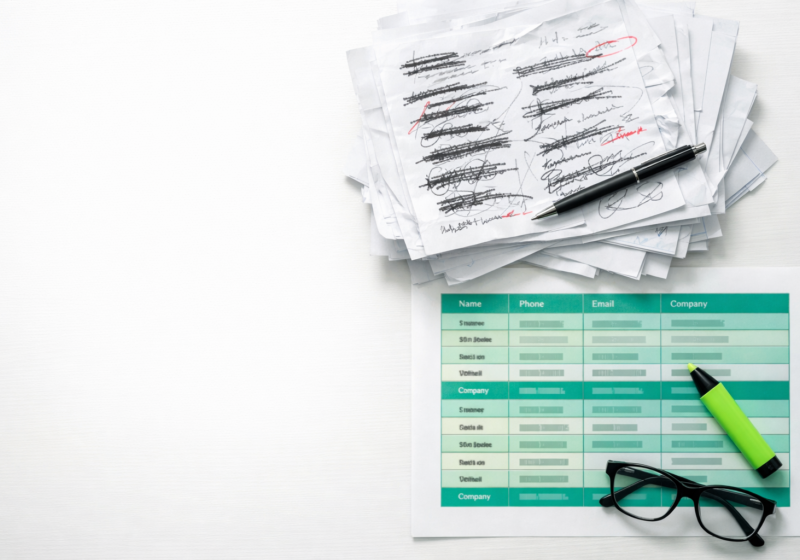
Another classic sign is when the same company or contact appears in your systems three different ways. For example, "ABC Ltd", "A.B.C. Limited" and "ABC Group" all sitting separately, each with partial information.
- Sales are unsure which record to update, so information gets scattered.
- Marketing accidentally sends duplicate communications.
- Reporting becomes unreliable because revenue is split across variants of the same customer.
From an operational standpoint, this is where simple tasks take longer than they should, and no one quite trusts the numbers. A proper cleanse that de-duplicates and standardises records can remove this friction and give you a single, reliable view.
Red flag 3: Reps keep saying they are “calling ghosts”
When sales teams complain that they are constantly hitting voicemail, wrong numbers, or contacts who left years ago, that is your field signal that the database has drifted away from reality.
- Connect rates on outbound calling are dropping.
- Named decision makers turn out not to work there any more.
- Prospects say "we do not handle that here" because the job title or site is wrong.
Every one of those failed dials or emails costs you money in wasted time. As Bec Burrows, Sales Director at Data HQ, puts it: "Every sales conversation is easier when you are calling the right person at the right company." Clean, current data turns more of that activity into real conversations.
Red flag 4: You cannot clearly show GDPR compliance
Finally, if you struggle to answer basic questions about consent, source of data, or when records were last updated, you have a risk issue as well as an efficiency issue. Data HQ has 25+ years of UK B2B data expertise since 2001, and the pattern is consistent. Where records are old and messy, compliance information is usually patchy too.
- Opt outs live in multiple systems and are not applied consistently.
- You are not sure which records are business contacts versus personal data.
- There is no clear audit trail of when and how details were collected or refreshed.
A structured B2B database cleanse, aligned with GDPR principles, helps you remove outdated records, correct contact details and rebuild a clear audit trail. That reduces risk and gives you confidence when running campaigns at scale.
What good B2B database cleansing looks like in practice
Spotting the red flags is one thing. The next step is putting a simple, repeatable process in place so your database stops drifting and starts supporting your sales and marketing plans.
1. Start with a data audit, not a guess
Rather than arguing about how bad things are, run a proper audit. When clients upload their data into Data HQ's audit tools, we typically see around 87% average match rate to external reference data and about 23% of addresses corrected on average. That gives you a factual baseline on:
- How many records are valid, duplicated or incomplete.
- How many addresses and phone numbers can be corrected.
- Where your biggest quality problems sit, for example by source or age.
With that picture, you can focus effort on the parts of the database that will give the biggest operational benefit.
2. Cleanse, de-duplicate and enrich in one pass
The most efficient approach is to treat cleansing as a combined exercise:
- Standardise company names, addresses and formats.
- Remove or merge duplicate companies and contacts.
- Correct and fill in key fields like postcode, phone and website.
- Where useful, append extra attributes such as SIC code, turnover or headcount.
A service like Revive from Data HQ does this by matching your records against trusted UK sources, including Companies House, credit reference agencies and commercial data providers, then feeding back a clean file you can trust.
3. Put a simple hygiene schedule in place
The real operational win comes from making B2B database cleansing a routine, not a rescue mission. For most B2B organisations, that means:
- Quarterly or bi-annual refreshes of core prospect and customer lists.
- Automated checks for duplicates and basic validation on new records.
- Clear ownership for who approves and loads bought-in data.
As Tim Holt, Managing Director at Data HQ, explains: "In B2B, your database is your pipeline. Neglect it and you are essentially leaving revenue on the table." A simple hygiene schedule keeps that pipeline flowing without constant firefighting.
If you are seeing any of these red flags in your own B2B database and want a clear view of how much it is really costing you, get in touch with our team. A targeted audit and cleanse often pays for itself quickly in fewer wasted calls, stronger campaign performance and a lot less operational frustration.


Explore more ideas
Let us open your mind to new possibilities
Our stories and ideas direct to your inbox